PCB stencil capabilities
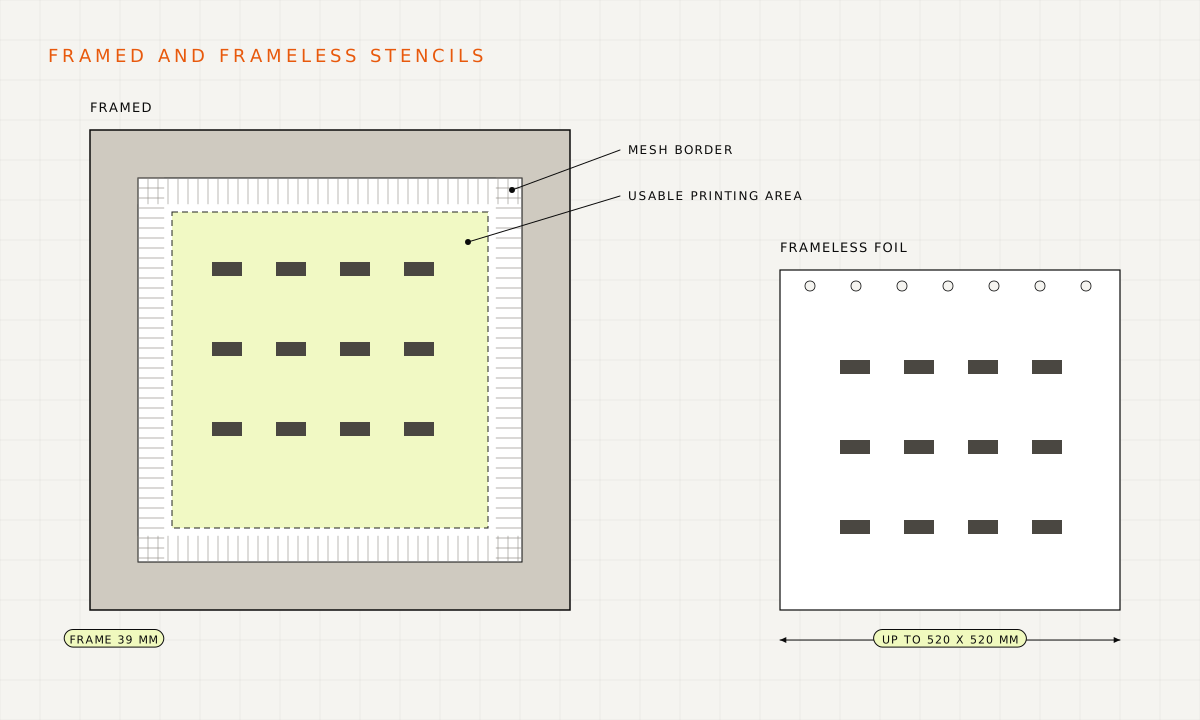
We laser-cut solder paste stencils from stainless steel, as frameless foils for a reusable tensioning frame or glued into a fixed frame for production printers. These are the sizes and thicknesses we make as standard.
- Largest frameless foil
- 520 x 520 mm
- Standard foil thickness
- 4 to 8 mil
- Aperture size accuracy
- ±5 µm
- Aperture position accuracy
- ±10 µm
Framed and frameless
| Frameless foil | Framed stencil | |
|---|---|---|
| How it is used | Clamped in a reusable tensioning frame on the printer | Foil bonded through a mesh border to a fixed aluminium frame |
| Best for | Prototypes and small batches; easy to store | Production printers and repeat builds |
| Cost | Lower | Higher |
| Process | Laser-cut stainless steel | Laser-cut stainless steel with polished aperture walls |
Sizes and thicknesses
| Frame size | Largest usable area |
|---|---|
| 29 x 29 in | 475 x 475 mm |
| 25 x 25 in | 460 x 460 mm |
| 23 x 23 in | 370 x 370 mm |
| 22 x 22 in | 350 x 350 mm |
| 20 x 20 in | 300 x 300 mm |
Frame profile width is 39 mm ±1 mm.
| Item | Standard capability |
|---|---|
| Largest frameless foil (usable area) | 520 x 520 mm |
| Standard thicknesses | 4, 5, 6 and 8 mil (0.10, 0.127, 0.15 and 0.20 mm) |
| Material and process | Stainless steel, laser cut |
| Aperture size accuracy | ±5 µm |
| Aperture position accuracy | ±10 µm |
| Optional coating | Nano coating on the foil for cleaner release at fine pitch |
Choosing thickness and apertures
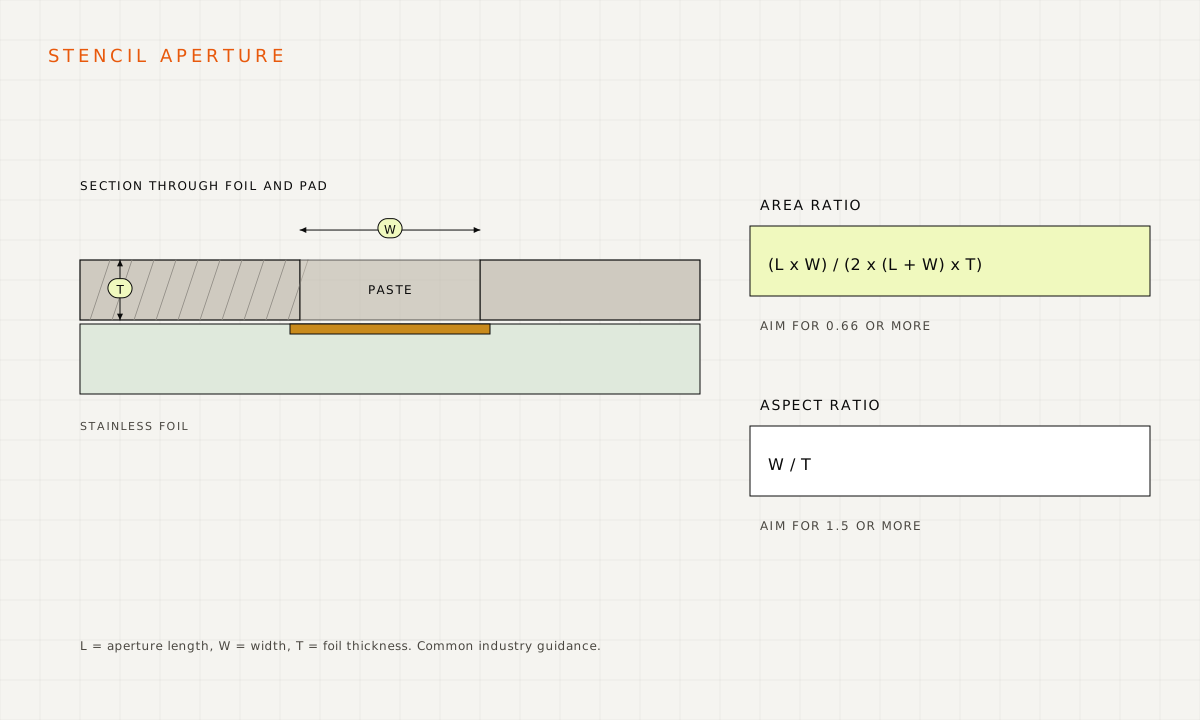
Thickness and aperture size together set the volume of paste on each pad. Too much paste bridges fine-pitch leads; too little leaves weak or open joints. The finest pitch on the board usually decides the foil thickness, and apertures for larger pads are then adjusted to suit.
| Finest pitch on the board | Typical foil thickness |
|---|---|
| 0.65 mm and above, 0603 and larger passives | 0.15 mm (6 mil) |
| 0.5 mm QFN and QFP, 0402 passives | 0.12 to 0.127 mm (5 mil) |
| 0.4 mm pitch, 0201 passives, small BGAs | 0.10 mm (4 mil) |
| Large through-hole pin-in-paste and power parts only | 0.20 mm (8 mil) |
These are common industry starting points. We check area ratios against your paste layer before cutting.
- Each side with SMD parts needs its own stencil.
- One stencil can carry several designs if they are printed together in a panel.
- Stainless stencils are reusable; clean them after each print run and store them flat.
Ready when your files are
Send your design for a quote
Upload your Gerber, drill and assembly files with the quantities you need. Our engineers check them against these guidelines and come back with a price, a schedule and any questions.